Babel 2.0
Matthew 24:4
"See that no one deceives you"
I have finished reading Pope Leo XIV’s encyclical Magnifica Humanitas on artificial intelligence, and although I read it from an evangelical perspective, I must acknowledge that it contains reflections that deserve serious consideration from all Christians.
I am not interested in entering into denominational debates. What interests me is the underlying question that runs throughout the entire document: what happens when humanity’s technological capabilities grow faster than its moral wisdom?
The encyclical does not present AI simply as a computer tool. It analyzes it as a cultural, anthropological, and spiritual phenomenon that could redefine the way we understand truth, freedom, work, human relationships, and even our own identity.
One of the aspects that caught my attention most was that the document is not afraid to point out something many celebrate without questioning: humanity is creating increasingly powerful systems without having solved the fundamental problems of the human heart.
The Bible teaches that humanity’s central problem is not a lack of information, but the condition of the heart. We have more knowledge than any previous generation, yet we continue to see wars, corruption, selfishness, exploitation, and lies. Technology multiplies our capabilities, but it does not transform our character.
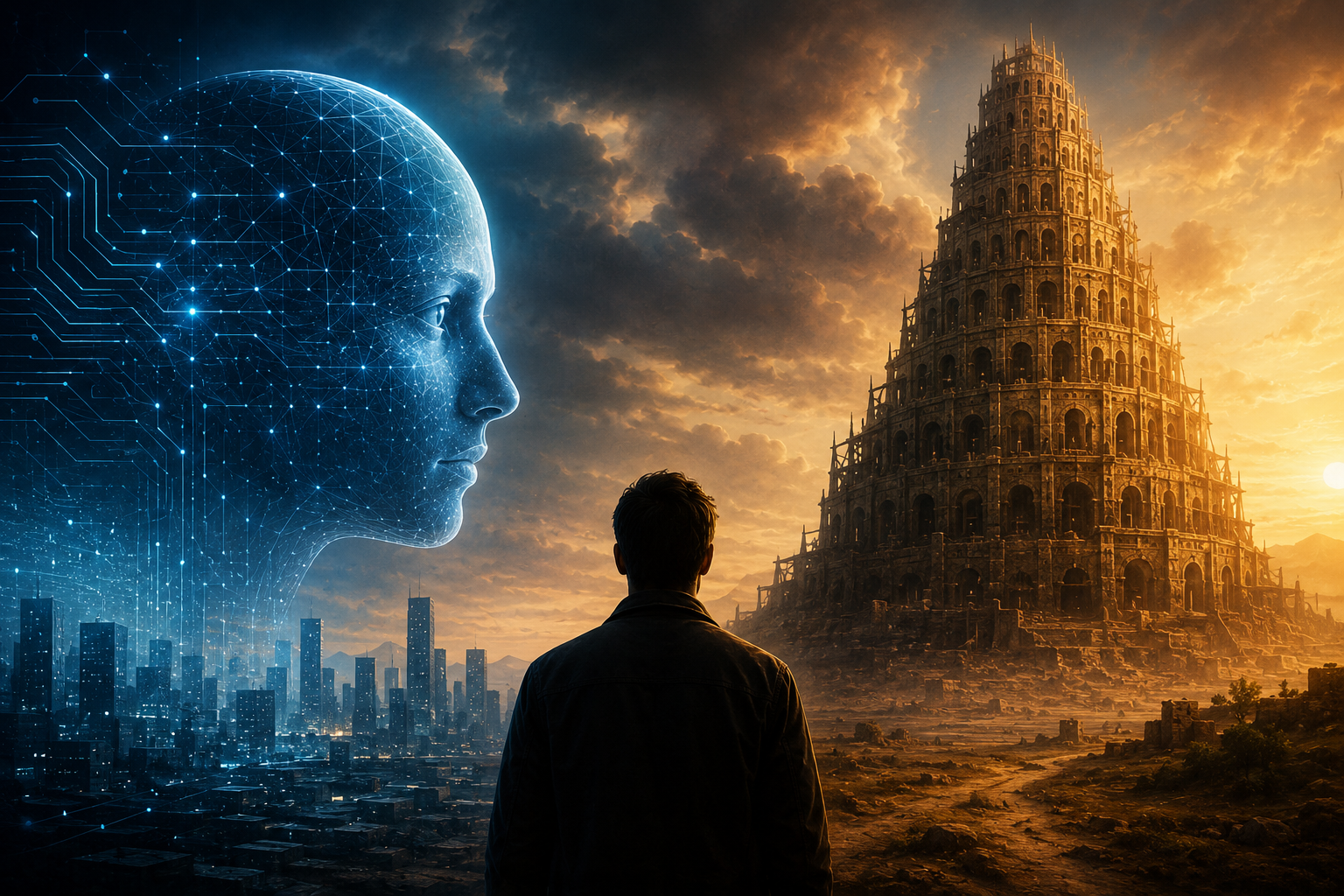
That is why the story of Babel immediately came to mind.
In Genesis 11 we find a humanity that was united, organized, innovative, and technologically advanced for its time. The problem was not the construction of the city or the tower. The problem was the purpose:
"Let us make a name for ourselves."
It was an attempt to build a civilization centered on humanity rather than on God.
As I read the encyclical, I had the sense that this warning runs throughout the entire document: technology can become a new Tower of Babel when it ceases to be an instrument and becomes a promise of salvation.
And here I find one of the deepest points.
For centuries, human beings have sought salvation in politics, science, economics, or ideologies. Today, many seem to place an almost religious faith in technology. AI is spoken of as the definitive solution for education, medicine, the economy, creativity, justice, and even human relationships.
But from a biblical perspective, no technology can solve the problem of sin, death, guilt, or the separation between God and humanity.
Only Christ can do that.
Another aspect I consider especially relevant is the reflection on truth.
We live in an age in which artificial intelligence can generate texts, voices, images, and videos that are practically indistinguishable from reality. This raises a question that goes beyond computer science:
How will we distinguish truth from deception when appearances are perfect?
I cannot help but relate this to Jesus’ words:
"See that no one deceives you" (Matthew 24:4, RV60).
The biblical concern regarding the last days was never simply technological, but spiritual. Scripture repeatedly warns about deception, the falsification of truth, and moral confusion. In that sense, AI’s current capabilities make those warnings more relevant than ever.
I also found the reflection on human dignity important.
AI can process information better than we can. It can perform calculations more quickly. It can produce impressive texts, images, and analyses.
But none of these capabilities defines a person’s worth.
The Bible affirms that human beings possess a unique dignity because they were created in the image and likeness of God. If a society begins to value people solely for their productivity, efficiency, or usefulness, it will end up dehumanizing itself, even if it possesses the most advanced technology in history.
The question is not whether machines will come to resemble human beings more closely.
The question is whether human beings will end up behaving like machines.
Perhaps the document’s most prophetic aspect is its warning about the concentration of power.
Never before in history have a few organizations had simultaneous access to so much information, so much surveillance capability, so much cultural influence, and so much ability to shape global public opinion.
I am not claiming that this is the direct fulfillment of any biblical prophecy.
But I do believe that we are facing tools that could facilitate scenarios previous generations could scarcely have imagined.
After reading the encyclical, my conclusion is not fear.
Nor is it naive enthusiasm.
It is the need to recover discernment.
More than ever, we need believers who are capable of thinking biblically, of distinguishing between progress and wisdom, between information and truth, and between technical capability and moral maturity.
Artificial intelligence will be one of the most powerful tools ever developed by humanity.
The decisive question will not be what AI can do.
The question will be whether human beings will continue to remember who they are, who created them, and what they were created for.
Because a civilization that conquers artificial intelligence but loses the fear of God may end up being highly advanced technologically and deeply impoverished spiritually.
Complete encyclical:
https://www.vatican.va/content/leo-xiv/es/encyclicals/documents/20260515-magnifica-humanitas.html